Warning: Trying to access array offset on false in /home/spain/webapps/es-greenblue-com/wp-content/plugins/elementor-pro/modules/dynamic-tags/tags/post-featured-image.php on line 39

Warning: Trying to access array offset on false in /home/spain/webapps/es-greenblue-com/wp-content/plugins/elementor-pro/modules/dynamic-tags/tags/post-featured-image.php on line 39

Warning: Trying to access array offset on false in /home/spain/webapps/es-greenblue-com/wp-content/plugins/elementor-pro/modules/dynamic-tags/tags/post-featured-image.php on line 39

Warning: Trying to access array offset on false in /home/spain/webapps/es-greenblue-com/wp-content/plugins/elementor-pro/modules/dynamic-tags/tags/post-featured-image.php on line 39

Warning: Trying to access array offset on false in /home/spain/webapps/es-greenblue-com/wp-content/plugins/elementor-pro/modules/dynamic-tags/tags/post-featured-image.php on line 39

Warning: Trying to access array offset on false in /home/spain/webapps/es-greenblue-com/wp-content/plugins/elementor-pro/modules/dynamic-tags/tags/post-featured-image.php on line 39

Warning: Trying to access array offset on false in /home/spain/webapps/es-greenblue-com/wp-content/plugins/elementor-pro/modules/dynamic-tags/tags/post-featured-image.php on line 39

Warning: Trying to access array offset on false in /home/spain/webapps/es-greenblue-com/wp-content/plugins/elementor-pro/modules/dynamic-tags/tags/post-featured-image.php on line 39

4 Methods of Accommodating Utilities in Tree Pit Design

We need trees in our cities – but preventing tree roots from interfering with infrastructure is an ongoing issue. Utilities and other services are frequently encountered during construction of tree pits, but what is the best way to accommodate them?

There are four main methods for creating service ducts through soil cells in tree pits, as described and illustrated here. You can view standard CAD details, or contact our design team to discuss FREE custom CAD details for your project.

Soil cell Link

This method utilizes the continuous link molded grating to bridge across the service corridor. The link is connected to the soil cell modules with stainless steel connectors for simple removal and reassembly, providing ready access to service pipes and conduits.

Strata Link


SOIL CELL Infill

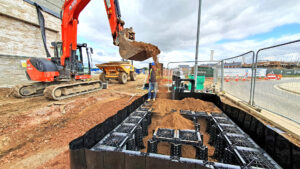
This method may be utilized for service corridors of 14″ (350mm) in width. The compact RC90 RootCell module is – in columns, and placed onto the sand layer surrounding the service pipe. These modules may then be loaded with soil concurrently with the adjacent StrataCell matrix, and finished with the geocomposite layer.

RootCell Infill


Granular Infill

This method entails placement of compacted granular material in the service trench, above the sand layer. Granular material is brought to level with the soil cell matrix, and overlaid with the geocomposite layer.

Granular Infill


Shallow Services

Where services may be relocated at shallower profiles, and pavement loads permit, the top soil cell layer may be amended to accommodate the pipe as shown. This method provides firm support for the service pipe or conduit, and more convenient access for repairs, if required.

Shallow Services


Root barriers systems that avert the problem by directing tree roots away from surrounding infrastructure and services, like ReRoot™ from GreenBlue, are the most effective when running utilities through tree pits. ReRoot™ is a continuous root barrier with integral, molded vertical ribs for preventing ‘root swirl’ and directing roots downward and outward. This high density root barrier is made from 100% recycled postindustrial material and is now supplied to the industry in 10″ and 20″ deep rolls. The benefits of utilizing ReRoot™ are two-fold – through developing a deeper root system, the tree gains greater drought tolerance and improved stability. This material is best laid before the tree is established, though often the barrier can be retrofitted around mature or existing trees after the roots have been pruned from the damaged services. One of the great features about this product is the flexible design allows the barrier to curve around obstacles but is rigid enough to hold its form when back-filling. It also protects the tree when sidewalk reinstatement work is carried out.
Every time it rains, millions of litres of relatively clean rainwater enter sewer networks that were never designed to carry

Lifted kerbs, cracked paving and uneven footpaths are often blamed on tree roots. It’s one of the biggest concerns surrounding

When urban tree planting projects are discussed, much of the conversation centres around the finished outcome. How much soil volume

Value engineering is part of modern construction. Every project is under pressure to deliver quality outcomes while maintaining programme and

Water companies have entered AMP8 with a clear objective: remove rainwater from overloaded sewer networks. The reasons are well understood.

For decades, the way we designed drainage in our towns and cities followed a simple principle: get water away from

A ‘Super El Niño’ is set to make 2027 one of the hottest years on record, with temperatures potentially exceeding

What stood out at UKREiiF 2026, across a range of sessions and conversations, was how often different speakers and disciplines

Raingardens are designed to manage rainfall where it lands. Instead of sending water straight into underground pipes, they slow, store

Urban tree populations in cities around the world are under pressure. Despite the clear benefits trees bring, including cooling streets,