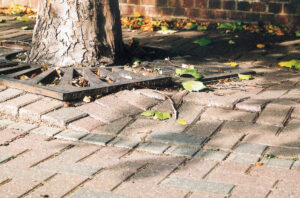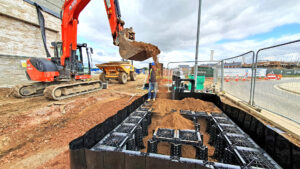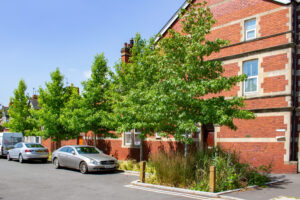
A Tree Pit is literally the hole in which a tree is planted. Sorry? The hole makes a difference?
Absolutely! But there is more to that hole than a casual glance will reveal. For a Tree Pit to be adequate for growth in an urban setting, there are three details that must be examined; soil conditions, root-growth restraints, and efficient engineering all play a vital role if trees are to successfully grow in a concrete world. If one or more of these is overlooked, a planting project could need a very expensive replacement much sooner than desired.
Soil Conditions
On the surface, a patch of soil looks perfect for growth…and it just may be. It may be perfect for a grouping of flowers or low-lying bushes. But trees are a whole different story. Will the tree have enough soil to progress through different stages of growth and develop into q healthy mature tree? This is perhaps the most critical question asked in designing green space in an urban setting. Bottom line – there needs to be enough quality soil in that Tree Pit. For instance, if at maturity you hope to have a tree develop to a three-meter canopy, it needs to have approximately four cubic meters of healthy soil beneath the surface. (See GreenBlue’s Soil Volume Calculator for assistance)
Soil in an urban setting is quite different from the soil of a forest floor. The designer needs to be sure that the soil is receiving proper moisture and nutrients in order to “trick” that tree in to growing to fruition. By altering the soil conditions and mimicking the atmospheric environment of where that tree organically grows, a tree found in the Amazon rainforest can also be found in an office atrium in The Peg or Cowtown.
Root-Growth Restraints
Surfaces and utilities often interfere with the proper growth of trees. It’s critical to comprehend fully what is happening underneath the concrete and use products that will assist in protecting roots and establishing barriers to anything that might deter healthy growth. It’s not essential that utilities be avoided altogether, but it is extremely critical that if utilities are nearby, well-developed products are designed to avoid them. Are you worried about a root system potentially cracking your nearby sidewalk? With GreenBlue Urban’s products, roots will be encouraged to grow down deep, rather than spreading and causing destruction.
Efficient Engineering
Trees do not grow naturally where there are small amounts of compacted soil and utility interference. That’s why it is critical that the engineers at GreenBlue Urban meet with your urban developers personally and explain their thriving approach to city development. GreenBlue and you will make an award-winning team, and you will see how its products and engineers work with you to develop breathtaking trees for generations to come.
Sadly, 50% of city trees die before they reach ten years of age. And even sadder yet, a little research and some trusted engineering could have changed the outlook of those trees immensely. There’s no need to waste valuable time and bucks! Instead, when assessing the long-term health and success in tree growth, it’s important to look at what’s happening underground. GreenBlue Urban is committed to doing the necessary research and providing an accurate design that results in the longevity your trees and your city deserve.