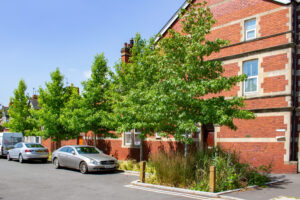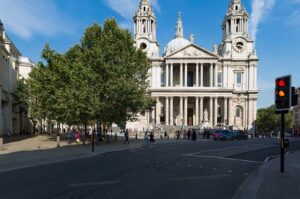
It is not an unknown fact that noise can reach unhealthy levels in urban areas. Cities across the world have acknowledged the impacts of noise pollution and enacted by-laws and practices to battle this increasing environmental issue.
Noise abatement has become an important consideration for many municipalities as they constantly look at ways of suppressing and dampening surrounding noise from nearby roads, railways, and airports. Urban trees can be used as sound barrier to reduce noise pollution. As with planting for wind or visual barriers, the selection and arrangement of the trees is key to a successful outcome. Where solid barriers such as fences are frequently used as sound barriers, trees and shrubs can also be effective. Where space permits, thick strips of vegetation in conjunction with landforms or solid barriers can reduce highway noise by 6 to 15 decibels (D.I. Cook). Because trees absorb more high frequency noise than low frequency, this makes them ideal for use as sound barriers.
Published results on the effectiveness of trees as sound barriers vary enormously, however, a study by Huddurt in 1990 shows that in some instances noise can he reduced by 6 dB over a distance of 30 meters where planting is particularly dense. Leonard and Parr (1970) and Reethof (1973) found that a dense belt of trees and shrubs between 15-30 m wide could reduce sound levels by as much as 6-8 dB. Cook and Van Haverheke (1972) found reductions in noise level of 5-10dB for belts of trees between 15-30m wide. Research also suggests that wide plantings (around 30 meters) of tall dense trees combined with soft ground surfaces can reduce apparent loudness by at least 50%.

How Trees Reduce Noise
Noise reduction is achieved by either deflection or absorption of the noise or a combination of the two (to be effective they should be as close as possible to the source of the noise). Most hardscape barriers on the other hand, work solely by deflecting sound (example 1 in above image). Earthen berms are often used in combination with trees and shrubs to deflect and absorb sound when the available space is limited (example 2). Large-leaved deciduous species may be more effective at reducing noise during spring and summer but evergreens will provide better results year-round.
In regards to tree size, it has been proven that noise reduction tends to increase with tree height up to 10-12m, after which it tends to decrease. This is a result of lower branches dying and allowing sound to travel more easily. Noise reduction is correlated with the width of a belt of trees, meaning the wider it is the greater the noise reduction. A screen placed relatively close to a noise source is more effective than one placed close to the area to be protected. However, at midway between the source and receiver, noise reduction is least.
There are several factors to be considered before deciding to create a tree barrier against noise.
- Noise is more effectively reduced by completely screening the source from view.
- A noise barrier should be planted as close to the noise source as possible.
- Wide belts of high density trees and shrubs are required to achieve significant noise reductions.
- Effectiveness of noise reduction is closely related to the density of stems, branches and leaves.
- For year-round noise reduction use broadleaved evergreens or a combination of coniferous and broadleaved evergreen species.
- Soft ground is an efficient noise absorber. Cultivating ground before planting and the addition of well-rotted organic matter to the soil surface may also help to reduce noise whilst vegetation becomes established.