In our increasingly dense towns and cities, we are having to find new and creative ways to get trees and other green elements to establish in constrained situations and around and over other buildings. Many developments are now maximising the potential of the site by building below ground – car parks, storage areas or other plant rooms – and then landscape over the top to create garden areas. Rooftop and balcony planting is becoming more and more common too, with some new communal outdoor areas being stunningly designed.
Planting grass and shrubs are relatively simple – as long as you have adequate water provision. Usually these scenarios, planting cannot access natural water sources, so automated irrigation is vital, as is a drainage outlet for any excess water.
When tree planting is under consideration, there are some critical considerations that must be taken into account. Firstly, what tree species is suitable, secondly, can we achieve a suitable uncompacted soil volume for the tree, and thirdly, can we adequately secure the tree, keeping it upright until the rooting system establishes itself.
In a number of situations such as these mentioned above, GreenBlue Urban has worked with leading landscape architects and engineers to create solutions to these challenges. Some sites can accommodate reasonable soil depths before the drainage layer and waterproofing membrane is reached, but many have limitations in this regard. These limitations can be due to weight constraints, or simple construction detailing – many developments use a lightweight void filler to create the illusion of soil depth but without the complication of tonnes of soil.
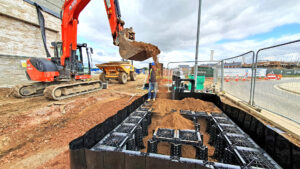
As always, GreenBlue Urban recommends planting trees in soft soil areas, but when these areas are not available, a soil cell system surrounding the root ball, supporting the paving, allows trees to root freely into all available soil volumes. Working on these confined projects, the height of buildup or layer works is critical, and many designers wrongly assume that any tree will need a minimum of 1000mm of soil build-up, which is frankly not usually available. Using the GreenBlue Urban StrataCell system, we have successfully managed to reduce the height requirement between the drainage layer and the underside of the paving build up to only 250mm, which opens up fresh opportunities in our urban areas.
Reducing the rooting “height” has other advantages too – it encourages the roots to spread outward more, increasing the tree’s access to water (wider area) and reducing the point load weight of the growing tree (also wider area).
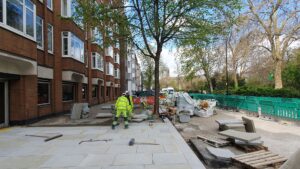
Another important deliberation is regarding access to not only the tree but for access to surrounding buildings. Many of these developments require MEWP or Firetruck access for maintenance and emergency, so when choosing the suitable solution, it is important to check that the load rating of the soil cell solution is adequate for the vehicular overrun that it may experience. The GreenBlue Urban StrataCell 60 series can carry over 60 tonnes per square metre – making it the strongest soil cell in the world. For lighter weight scenarios, the StrataCell 30, or the RootSpace systems are often installed.