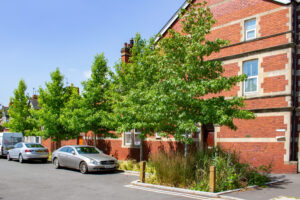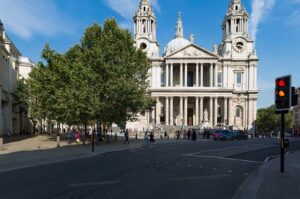
Planting trees into streets, plazas and other hard landscapes is now a fundamental part of creating greener, healthier and more resilient urban environments.
But planting a tree and successfully establishing a mature urban tree are very different things.
Trees in hard landscapes can struggle to reach their expected size, develop sparse canopies or decline prematurely. While there can be many contributing factors, one of the most important is the environment provided below ground.
Urban trees need sufficient volumes of suitable soil, together with water, oxygen, nutrients and space for their roots to develop.
When those conditions are compromised, the tree’s long-term performance can be compromised too.
Why Are Hard Landscapes Difficult for Trees?
Trees have evolved to grow in soil environments where roots can explore relatively large volumes of ground.
Natural soils contain pore spaces through which air and water can move. Roots can extend in search of moisture and nutrients, while organic matter and biological activity contribute to maintaining a functioning soil ecosystem.
Hard landscapes have very different requirements.
Roads, pavements and public spaces need to support pedestrians, vehicles and other loads. To achieve this, the ground beneath them is commonly compacted to create a stable structural base.
That creates a basic conflict.
The pavement needs structural support. Tree roots need soil that remains sufficiently uncompacted to allow root growth, water movement and gaseous exchange.
If the tree is planted directly into a small volume of soil surrounded by heavily compacted material, its roots can quickly exhaust the suitable growing environment available to them.
What Causes Urban Trees to Fail?
There is rarely a single cause of tree failure.
Poor establishment can result from a combination of factors including:
- insufficient soil volume;
- excessive soil compaction;
- poor soil quality;
- restricted drainage;
- waterlogging;
- insufficient irrigation;
- inadequate aeration;
- surrounding utilities and structures;
- inappropriate tree selection; and
- poor installation or maintenance.
These factors are closely connected.
For example, a tree may technically have access to a large volume of ground, but if that soil is heavily compacted, roots may be unable to use it effectively.
Similarly, good-quality soil will provide limited long-term benefit if there is simply not enough of it to support the anticipated mature tree.
Successful urban tree planting therefore requires the complete rooting environment to be considered rather than focusing on one individual component.
Why Is Soil Compaction Such a Problem?
Soil contains spaces between its particles.
These pores allow air and water to move through the soil and provide space for roots to grow.
When soil is heavily compacted, those spaces are reduced.
This can restrict root penetration, slow drainage and reduce the movement of oxygen through the soil.
The result can be an environment capable of supporting the pavement above but poorly suited to sustaining a tree below.
This is particularly important because the physical size of a tree pit does not necessarily represent the amount of usable soil available to the tree.
A large area of highly compacted growing media may offer considerably less useful rooting environment than the dimensions suggest.
Why Is Soil Volume Important?
As a tree grows, so does its demand for water, nutrients and rooting space.
A relatively small tree pit may be enough to install a young tree, but it may not contain sufficient resources to support that tree when it is significantly larger.
Providing an appropriate volume of healthy soil allows roots to spread and gives the tree access to greater reserves of water and nutrients.
This is directly connected to canopy development.
If below-ground conditions restrict growth, the tree may never develop the large, healthy canopy expected when it was originally specified.
That matters because many of the benefits associated with urban trees increase as the tree grows.
Shade, cooling, rainfall interception, evapotranspiration, biodiversity value and visual impact are all closely connected to canopy size and tree health.
Designing for the mature tree therefore requires sufficient below-ground capacity from the outset.
What About Structural Soil?
Structural soils were developed as one way of creating rooting opportunities beneath hard surfaces.
They typically combine load-bearing aggregate with soil, allowing the material to be compacted sufficiently to support the pavement while retaining some growing media within the spaces between the aggregate.
Different systems include rock-and-soil matrices and other structural growing media.
They can provide rooting opportunities in locations where conventional compacted sub-base would provide very little.
However, there is an important distinction between the overall volume occupied by structural soil and the volume of actual soil available to the tree.
A significant proportion of the system consists of aggregate required to provide structural support.
The growing medium itself must also exist within a compacted structural environment.
Where structural soil is specified, its available soil volume, compaction, nutrient availability and suitability for the proposed tree should therefore all be considered.
How Are Soil Cells Different?
Soil cells take a different approach.
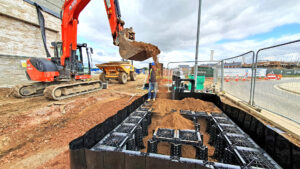
Instead of making the growing medium itself responsible for supporting the pavement, a structural framework carries the load above.
The space within the structure can then be filled with suitable soil for root growth.
This separates two competing requirements.
The pavement receives the structural support it needs, while the tree gains access to a much larger proportion of usable soil.
GreenBlue Urban began developing soil cell technology during the 1990s as a way of increasing the volume of suitable growing media that could be provided beneath paved urban environments.
Modern systems such as RootSpace are designed to create structurally supported rooting environments beneath hard surfaces while allowing trees access to large connected soil volumes.
Why Does Connected Soil Matter?
Roots do not simply remain within the small opening visible around the tree trunk.
As a tree matures, its root system needs to extend horizontally and vertically through the surrounding soil.
In constrained streets, it is often impossible to provide all of this growing space within an open planting area.
Engineered tree pits allow suitable soil to extend beneath adjoining pavements and other hard surfaces.
This can make much more effective use of limited underground space.
The shape of the rooting environment can also be designed around utilities, foundations and other constraints rather than assuming every tree pit needs to be a simple rectangular excavation.
What matters is providing an appropriate connected volume of usable growing media.
Irrigation, Aeration and Drainage Matter Too
Soil volume alone does not guarantee success.
The soil also needs appropriate access to water and oxygen.
If a tree pit becomes waterlogged, oxygen within the soil pores can be displaced. If the soil remains too dry, the tree may experience drought stress.
Similarly, if irrigation is concentrated only at the surface, deeper areas of the available soil may not be used as effectively.
Tree pit design should therefore consider irrigation, aeration and drainage alongside soil volume.
Systems such as RootRain can help water and oxygen reach deeper areas of the rooting environment, encouraging roots to make better use of the soil provided.
The aim is to create a functioning below-ground environment rather than simply a large excavation.
What About Tree Roots and Pavements?
Tree roots are often blamed when pavements lift or crack.
But roots grow in response to the conditions around them.
If suitable soil, water and oxygen are limited below ground, roots may exploit more favourable conditions closer to the surface.
Providing a larger volume of suitable soil at depth, combined with effective root management where required, can help reduce the likelihood of conflict between roots and surrounding infrastructure.
This is another reason why pavement design and tree pit design should not be considered separately.
The most successful schemes design the hard landscape and rooting environment together.
Designing for Long-Term Tree Success
Successful urban tree planting requires more than selecting an appropriate species and creating an opening in the pavement.
The conditions below ground need to support the tree throughout its intended life.
That means considering:
- how much usable soil the mature tree will need;
- how compacted that soil will be;
- how water enters and leaves the rooting environment;
- how oxygen reaches the roots;
- how utilities and other infrastructure will be accommodated;
- how roots will interact with surrounding surfaces; and
- how the tree pit will continue functioning decades after installation.
Hard landscapes do not have to be hostile environments for trees.
But successful establishment depends on resolving the conflict between the structural requirements of the city and the biological requirements of the tree.
When those below-ground conditions are designed correctly from the outset, urban trees have a much greater opportunity to establish, mature and develop the healthy canopies our towns and cities need.