Whilst tree roots can grow deep into the ground, most tree species that we plant in the UK streets are relatively shallow rooting (most of the roots within the top one metre) – depending on the geology. It is these rooting patterns that tend to cause long term problems with surrounding hard surfaces, but tree roots can be trained to establish at a deeper level by using root management.
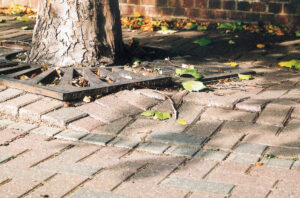
Tree roots are opportunistic – they will find the route of least resistance; often this means that roots spread out superficially and once established, thicken up and because of the secondary thickening process (which can exert huge forces), hard surfacing begins to crack.
So how can we avoid this? By understanding root morphology and the needs of the tree we can design a system of root management that will allow the tree to grow and become established at the same time as restricting the roots from growing into zones where they could cause problems.
The first consideration is to provide adequate rooting volume; enough uncompacted soil is vital if any tree is to attain a healthy established state. The temptation to wrap a rootball with a ReRoot root barrier must be resisted, as it will inevitably cause root girdling, which will kill the tree in the medium to long term, and more importantly, it is likely that the tree will be unstable because the roots will not be able to spread out. The tree will also be likely to suffer in dry periods, as restrictive root barriers do limit the trees access to water sources below ground. Ideally, ReRoot root barriers should be installed as far from the tree as possible – think of them as service barriers, protecting the utilities rather than protecting the roots.
RootDirectors and ReRoot ribbed root barriers have internal ribs which discourage root girdling and guide roots to a lower level. Any root barrier that is going to cover more than 25% around the rootball should use a ribbed system to prevent girdling. When specifying the depth of root management, GreenBlue Urban always recommends a minimum of 250mm deeper than the item that is being protected; for example, if there is a service at 750mm deep, a 1000mm deep barrier is the minimum depth that should be used. In certain circumstances, it is suggested that the bottom of the root barrier should be secured in concrete as some vigorous rooting systems such as Willow (Salix) can burrow beneath shallow barriers.
In scenarios where a ReRoot 2000 flat root barrier is to be used as a linear protection system, the barrier should continue at least 3m beyond the final anticipated canopy size to ensure that roots do not escape around the barrier.
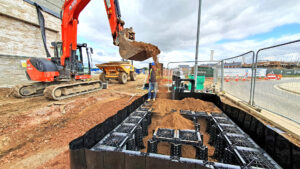
The very latest innovation in root management is the RootForm modular root director system, which also provides a structural concrete haunch around the primary rooting zone of the rootball. This structural element ensures that there is a strong base for the installation of a tree grille and makes sure that the surrounding hard surface build-up does not cause the root director to become deformed. Because of the modular formation, it also gives opportunities for multiple tree planting within one root director, potentially saving money and making more versatile schemes possible.
One final point is that it is important to use an impermeable barrier. If water can penetrate, fine fibrous roots finally will follow. All of the GreenBlue Urban Root Management products are manufactured from 100% recycled material: not only saving hard surfacing and utilities but the planet too.