To appreciate the significance of project awards for sustainability in urban development, as we’ve discussed in previous posts, it is worth considering the historic struggle to gain acceptance of the benefits to be realised from the elevation of town planning to its current importance.
The term town planning was first used in Britain in 1906. The statutory practice of town planning stemmed from the Housing, Town Planning Act 1909. Local authorities, under the supervision of the Local Government Board were empowered to prepare schemes for land likely to be developed particularly in suburban areas. They regulated both the layout of land and the density of development, while reserving land for new highways.
At that stage town planning had not established itself as an art or science, but practitioners found benefit from seeing their work as distinctive within a range of professions engaged in this field – architecture, surveying, municipal engineering, and law.
In 1910 Thomas Adams, who played a leading part in discussions between these four collaborating professions, was appointed as the first Town Planning Inspector at the Local Government Board. The regular meetings of a small group of these practitioners resulted in the recognition of town planning as a distinct discipline.
Organisations like the Royal Town Planning Institute (RTPI) and the American Planning Association (APA), pursue the advancement of the art and science of urban planning for the public benefit. They champion the role of spatial planning – planning which gives people a real say in shaping the places where they live and work – and ensures that creating a safe, sustainable place is recognised as vital to attractive community environments.
Post-industrial revolution decay and post-war austerity yielded a legacy of brutalist sink estates smothering opportunities of upward mobility and consigning whole neighbourhoods to rapid decay and concomitant crime. For much of the 20th Century, the RTPI struggled to escape a Cinderella image, regarded as something to be tolerated.
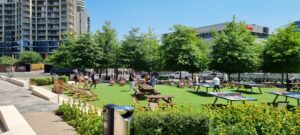
Community sustainability is now a prime consideration in all significant urban development and planning. The past twenty-five years have been an age of enlightenment environmentally. The social and economic benefits of open spaces and urban afforestation have revolutionised both the art and science of spatial planning with the application of biophilic principles assuming priority status instead of being just a desirable add-on.
Biophilia – the new environmental paradigm – is a term popularised by Harvard University myrmecologist (the study of ants!) and conservationist E.O. Wilson over the past quarter century describing the extent to which humans are hard-wired to need connection with nature and other forms of life. Support for the practice of biophilic design is growing.
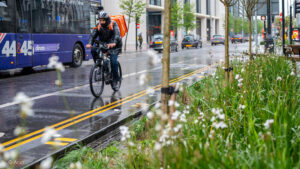
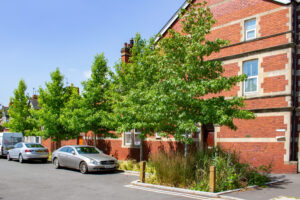
Today, the greening of the urban environment is recognised as a major contributor to regeneration projects improving the sustainability ratings of towns and cities. The tangible benefit of regenerated, green and pleasant urban environments has reversed the downward post-industrial spiral. This virtuous circle gains momentum with the rising expectation of residents and workers for the ambience of natural surroundings.
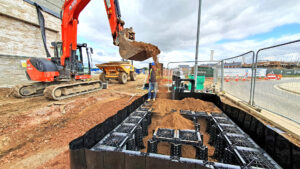
Such regeneration schemes have demanded ingenious solutions to challenges such as how to accommodate established service infrastructure. GreenBlue Urban, aware from experience of the shortage of solutions, quickly became involved with university and professional academics in exploring revolutionary materials and structures to disrupt sclerotic traditional practices and provide cost-effective ways to restore the sustainability of green urban environments.
David Bowie