Successful urban tree planting depends on much more than what happens at the surface.
Trees need access to sufficient soil, water, oxygen and nutrients throughout their rooting environment if they are going to establish successfully and develop into healthy, mature specimens.
In natural environments, these conditions are created by relatively uncompacted soil, organic matter, rainfall and the continuous exchange of air and water through the soil profile.
Urban environments are very different.
Roads, pavements and other hard surfaces require heavily engineered ground conditions, while construction activity can further compact soils and restrict their natural structure. If water and oxygen cannot move effectively through the soil, tree roots can struggle to access the resources they need.
This is why irrigation and aeration need to be considered as part of the below-ground tree pit design from the outset.
Why Do Tree Roots Need Oxygen?
Tree roots respire.
Like the parts of the tree above ground, roots need oxygen to function effectively. Healthy soil contains pore spaces that allow oxygen to move into the soil and carbon dioxide to move out.
When soil becomes heavily compacted or waterlogged, those pore spaces can become restricted or filled with water.
This dramatically slows the movement of gases through the soil.
Research cited by Hillel in 1998 found that gas diffusion through water is only a tiny fraction of the rate at which gases move through air. When soil remains saturated for extended periods, oxygen availability around the roots can therefore fall significantly.
Poor aeration can affect root function, microbial activity and the wider biological processes that contribute to a healthy soil environment.
Providing adequate soil volume is important, but that soil must also remain sufficiently aerated for the roots to use it effectively.
Why Surface Irrigation Isn’t Always Enough
Water applied at the surface does not necessarily reach the full rooting environment.
This is particularly important in urban tree pits surrounded by paving or other impermeable surfaces.
Shallow irrigation systems can provide water close to the surface, but if moisture repeatedly remains concentrated within the upper layers of soil, deeper areas of the rooting zone may not receive the same benefit.
This can influence how roots develop.
Tree roots grow where the conditions are most favourable. If water and oxygen are consistently available close to the surface, roots may become concentrated within those shallower soil layers rather than exploring the wider soil volume provided for them.
Deep irrigation aims to distribute water further into the rooting zone, encouraging the tree to make greater use of the available soil.
This can help create a more resilient rooting environment and reduce dependence on favourable conditions immediately beneath the pavement.
Encouraging Deeper Root Development
Root growth responds directly to the conditions within the soil.
Roots need access to water, oxygen and nutrients, and will generally extend into areas where these resources are readily available.
In urban environments, poorly designed tree pits can unintentionally create favourable conditions close to the surface while leaving deeper areas compacted, dry or poorly aerated.
This can contribute to shallow rooting.
Where roots are concentrated immediately beneath paving, the potential for interaction with surrounding hard surfaces can increase as the tree develops.
Providing suitable growing conditions deeper within the soil profile encourages roots to explore a greater proportion of the available rooting environment.
This does not mean that roots can be forced to grow in a particular direction. However, tree pit design can significantly influence where favourable rooting conditions are created.
Irrigation and Aeration Work Together
Water alone is not enough.
Urban tree pits need to balance moisture availability with sufficient oxygen in the soil.
Too little water creates drought stress. Too much water, particularly where drainage is poor, can fill soil pore spaces and reduce the oxygen available to roots.
The objective is therefore not simply to put as much water as possible into the tree pit.
A successful design needs to consider how water enters the rooting environment, how it is distributed through the soil and how excess water can drain away.
Aeration is part of the same process.
Creating routes through which air can reach deeper areas of the tree pit helps maintain the exchange of oxygen and carbon dioxide throughout the rooting zone.
Together, irrigation, drainage and aeration help create a soil environment that supports healthy root function.
Why Soil Structure Matters
The effectiveness of any irrigation or aeration system depends on the soil surrounding it.
Healthy soil contains a network of pore spaces that allow air and water to move through the profile.
Compaction reduces these spaces.
This can restrict drainage, slow gas exchange and make it physically more difficult for roots to extend through the soil.
Waterlogging can create similar problems by replacing the air within soil pores with water.
Urban tree pit design therefore needs to address the complete below-ground environment rather than treating irrigation as an isolated component.
Soil volume, soil structure, drainage, irrigation and aeration all need to function together.
What Role Does Organic Matter Play?
Organic matter is another important component of healthy urban soil.
It contributes to soil structure and helps create conditions in which water, air and nutrients can move through the rooting environment.
Organic matter also supports biological activity within the soil.
One particularly important relationship is the interaction between fine tree roots and mycorrhizal fungi. These fungi form associations with tree roots and can help trees access water and nutrients within the surrounding soil.
Maintaining suitable soil conditions helps support these biological processes.
Again, this reinforces the importance of creating a healthy soil profile throughout the rooting zone rather than concentrating tree care only at the surface.
Designing Irrigation Into Urban Tree Pits
GreenBlue Urban developed the RootRain irrigation and aeration system in 1992 to help deliver water and oxygen deeper into urban tree pits.
Rather than relying entirely on surface watering, the system allows water to enter deeper areas of the rooting environment.
When combined with an appropriately designed soil volume, this can help distribute moisture through more of the available growing media and encourage roots to establish throughout the tree pit.
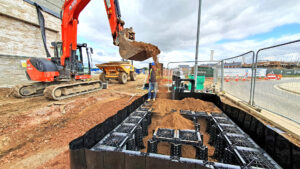
Structural soil cell systems such as RootSpace can also provide protected volumes of uncompacted soil beneath paved areas.
Used together, the objective is to create the conditions roots require while maintaining the structural performance of the hard landscape above.
The soil cells support the pavement, while irrigation and aeration systems help water and oxygen reach the growing medium below.
Can Deep Irrigation Help Reduce Conflict With Pavements and Utilities?
Roots do not deliberately damage pavements or underground infrastructure.
They grow towards areas where water, oxygen and nutrients are available.
If the best growing conditions are immediately beneath the surface or within disturbed utility trenches, roots are more likely to explore those areas.
Creating suitable conditions within the intended rooting zone can help reduce this pressure.
Providing sufficient volumes of uncompacted soil, distributing water deeper into the profile and maintaining adequate aeration all encourage the tree to make use of the environment designed for it.
Utilities can also often be incorporated within properly designed tree pit systems, allowing trees and essential infrastructure to coexist within constrained urban spaces.
Designing for the Whole Rooting Environment
Urban tree success depends on treating the below-ground environment as a complete system.
It is not enough to provide a tree pit of a certain size if the soil within it becomes compacted, poorly drained or inaccessible to water and oxygen.
Equally, simply adding an irrigation system does not compensate for inadequate soil volume or poor soil structure.
Successful tree pit design brings these elements together:
- sufficient connected soil volume;
- suitable, uncompacted growing media;
- effective drainage;
- access to water throughout the rooting zone;
- adequate aeration;
- consideration of utilities and other below-ground constraints; and
- a design that supports the anticipated mature size of the tree.
The aim is not simply to keep a newly planted tree alive.
It is to create a below-ground environment capable of supporting that tree as it establishes, grows and matures over decades.
Deep irrigation and aeration form an important part of that environment, helping ensure the soil provided to the tree can actually function as intended.