Successful urban trees need more than space above ground. Below the surface, they need access to sufficient volumes of nutrient-rich, moist, well-aerated and uncompacted soil if they are going to establish, mature and deliver their intended benefits over the long term.
The difficulty is that streets and public spaces have very different requirements. Pavements, roads and other hard surfaces need a stable structural base capable of supporting loading, while tree roots need soil that remains sufficiently uncompacted for water, oxygen and nutrients to move through it.
Different approaches have been developed to overcome this conflict. Two commonly specified solutions are structural soils and soil cell systems. Although both are designed to enable tree planting beneath hard landscapes, they work in fundamentally different ways.
What Is Structural Soil?
Structural soil uses a mixture of crushed stone and soil to create a material that can support the pavement above while providing some growing medium for tree roots.
A typical structural soil may consist of approximately 80% crushed stone and 18–20% soil. The mixture is then compacted to around 95% Proctor density to provide the structural support required beneath the surface.
The stone creates the load-bearing framework, with soil occupying the spaces between the aggregate. Tree roots must therefore grow through and around the stone to reach the available soil, water and nutrients.
This allows trees to access some growing medium beneath areas that would otherwise contain heavily compacted conventional sub-base. However, the proportion of actual soil available to the tree is relatively limited.
How Are Soil Cells Different?
Soil cell systems approach the same problem differently.
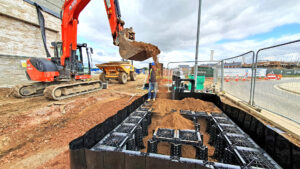
Rather than making the soil itself structural, the cell system carries the loading from the pavement above. This creates a protected underground space that can be filled with uncompacted or lightly compacted soil suitable for root growth.
The result is a much greater volume of usable growing medium within the same below-ground area.
This distinction is important. A cubic metre of space occupied by structural soil does not provide a cubic metre of soil to the tree because much of that volume is made up of stone. Within a soil cell system, a much greater proportion of the available volume can be dedicated to growing media.
For urban trees expected to establish large, healthy root systems and mature successfully, the quantity and quality of accessible soil can have a significant influence on long-term performance.
Structural Soil vs Soil Cells: Are They Equivalent?
Structural soil and soil cells can sometimes appear alongside one another within specifications as alternative methods of creating load-bearing growing environments beneath pavements.
However, they should not automatically be considered equivalent.
Both can provide opportunities for roots beneath hard surfaces, but the growing conditions they create are different. Structural soil relies on a compacted stone matrix containing relatively small quantities of soil, while soil cells separate the structural function of the pavement from the soil beneath it.
Understanding this difference is important when assessing how much genuinely usable soil volume a proposed tree pit will provide.
This becomes particularly significant on constrained urban sites where every cubic metre of available rooting volume matters.
What Does the Research Show?
GreenBlue Urban participated in research undertaken at Bartlett Tree Research Laboratories in North Carolina to investigate how trees performed within a range of load-bearing soil systems.
Tulip poplar trees were planted within trenches approximately two feet deep and five feet wide, designed to replicate conditions beneath a typical urban pavement.
Six different below-ground treatments were tested, with each plot containing approximately 42 cubic feet, or around 1m³, of treatment volume.
The treatments included:
- Standard soil compacted to approximately 80% Proctor density as a control.
- A heavily compacted control at approximately 95% Proctor density to represent typical urban conditions.
- Two different soil cell systems.
- A sand-based structural soil consisting of four parts medium concrete sand, one part topsoil loam and 1.5 parts mature compost, compacted to approximately 94–96% Proctor density.
- Structural soil consisting of approximately 80% #5 stone, 18–20% soil mix and 0.003% hydrogel, compacted to 95% Proctor density in accordance with Cornell University’s CU Structural Soil specification.
The intention was to compare how effectively each system supported tree establishment and growth beneath a load-bearing surface.
The Results After One Year
Differences became apparent much earlier than anticipated.
After just one year, measurements of tree height and canopy spread showed that the trees planted within the soil cell systems had significantly outperformed those growing within the other treatments. The GreenBlue Urban soil cell system recorded the greatest tree growth within the trial.
The speed at which these differences became visible was particularly notable.
The research had originally been expected to continue for between five and ten years. However, the variation in tree health and growth was sufficiently clear after the first year that meaningful conclusions could already be drawn.
Dr Thomas Smiley, Arboricultural Researcher at Bartlett, who directed the research, explained that the team was seeing significant differences in tree health and growth between the soil-under-pavement treatments. Even before the full data had been analysed, he commented that the photographs told much of the story.
Why Soil Volume Matters
The findings reinforce an important principle in urban tree pit design: providing space beneath a pavement is not the same as providing usable soil.
Trees need access to adequate volumes of suitable growing media throughout their development. When available soil is fragmented, highly compacted or limited in volume, root development can also become restricted.
Soil cell systems allow the pavement and rooting environment to perform separate functions. The structural framework supports the surface above, while the space within it can provide the uncompacted soil needed for root growth, water movement, aeration and nutrient availability.
This becomes increasingly important where trees are expected to grow to maturity and provide long-term benefits such as canopy cover, shade, cooling, biodiversity, rainfall interception and improved public realm.
Choosing the Right Approach
There is no single below-ground solution for every urban tree planting project. Site conditions, available space, loading requirements, drainage, utilities, tree species and long-term objectives should all influence the design.
However, when structural soil and soil cells are being compared within a specification, it is important to look beyond the total volume of the system.
The key question is how much suitable, accessible growing medium the tree will actually have.
For trees expected to thrive for decades within demanding urban environments, creating the right conditions below ground is one of the most important decisions made during the design process.